Showing posts with label Thriller. Show all posts

Book Publishing Secrets with Jörg H. Trauboth #books #bookpublishing


Jörg H. Trauboth, born in 1943 near Berlin, logged over two thousand flight hours as a Weapon Systems Officer Instructor in the Luftwaffe, flying PHANTOM F-4F / RF-4E and TORNADO fighter jets, and over 3000 hours in light aircraft. At the age of fifty, he left the service with the rank of Colonel in the General Staff. He received training as a Special Risk Consultant from the English Control Risk Group and served as Managing Director Germany, dealing with extortion and kidnapping cases in South America and Eastern Europe. Shortly thereafter, he founded his own consulting firm, quickly establishing an outstanding international reputation. Trauboth protected his clients with a 24-hour task force during product extortions, product recalls, kidnappings, and image crises. He was the first President of the European Crisis Management Academy in Vienna and President of the American Yankee Association.

He is known as a respected expert in the media on security-related topics. He volunteers as an emergency counselor and is a member of the Crisis Intervention Team (KIT Bonn) of the German Foreign Office. He is a private pilot, married, with two sons and three grandchildren.

In 2002, Trauboth wrote the now out of print standard work “Crisis Management for Company Threats”.

In 2016 the follow-up work was published with Jörg H. Trauboth as editor in collaboration with five authors: “Crisis Management in Companies and Public Institutions”.

Terror expert J. H. Trauboth presented his debut novel in 2015 with the Germany thriller “Three Brothers”. (Available in English). In 2019 “Operation Jerusalem” followed and in 2020 “Omega”. The trilogy is about the former elite soldier Marc Anderson and his team. With these three self-contained thrillers, Trauboth is rated by many readers as the “German Tom Clancy.” The trilogy is available as a printed edition, eBook and audio book.

His first detective novel, “Jakobs Weg” (German), followed in 2021. The highly explosive topic of “sexual abuse of children” is processed sensitively in a scenario on the Way of Saint James and at the end offers contact options for those seeking help.

In 2022, the novella “Bonjour Saint-Ex” was published (German) in which the passionate pilot Jörg H. Trauboth turns the last flight of the legend Antoine de Saint Exupéry into an exciting literary event.

Readers wanted a sequel to the Marc Anderson series. In 2023, ZarenTod – Das Ende der Präsidenten was published, a highly topical political thriller. The Russian president and new tsar, Ivan Pavlenko, suddenly shows his true face during the war in Ukraine. He wants the old Soviet Union back. The world is on the brink. The influential oligarch, Alexei Sokolov, wants to prevent Ivan’s megalomaniac plans and is planning a fundamental new beginning for Russia. To achieve this, the Russian president must be removed. But the plan goes awry. Ex-elite soldier Marc Anderson intervenes. Will Czar Ivan die? What will become of Europe? The book 8/ 2024 in English „The Death of the Kremlin Czar” is the fourth political thriller in the Marc Anderson series.

Website & Social Media:

Website ➜  https://trauboth-autor.de/english/

Twitter ➜ https://twitter.com/JorgTrauboth


📙 Thank you for your time in answering our questions about getting published.  Let’s begin by having you explain to us why you decided to become an author and pen this book?


First of all, thank you very much for giving me the opportunity to share some of my experiences as a writer. I'm very glad that I don't have to make a living from this genre. In fact, I've been writing out of passion all my life. I won a few awards for it in the military. But it was only after I had finished my time as a professional soldier that I learned what is necessary to become a respected author.  I learned how to design a plot, learned different types of storytelling and how to captivate the reader. I learned more from book to book. The reviews were great, but unfortunately not the sales. That didn't set me back. A book is like a baby that wants to be born. In my thrillers, I also have the unique opportunity to create a world that is better than the previous one. And to invent people in whom I find myself. If I gave up writing, my life wouldn't be as full as it is now.

📙 Is this your first book? 

THE DEATH OF THE KREMLIN CZAR is my seventh book since 2015 and my second in English. Among these books are four thrillers of the Marc Anderson series, a thriller about child sexual abuse, a novella about the French poet Antoine de Saint-Exupéry and two non-fiction books about crisis management. Actually, all the books have something to do with me because good crisis management is my passion.


📙
With this particular book, how did you publish – traditional, small press, Indie, etc. – and why did you choose this method?


I am an author from Germany. So there may be differences to other countries in terms of my experiences. But I read the US book market is even more challenging than those in Europe. I was contacted by a well-known German publisher for my non-fiction book. It went easily. I got the kind of professional support you would expect. My other books were printed in the traditional way by a small publisher who also covered all the costs but had no resources for marketing. All books are available in print and as e-books, three as audiobooks. But all books have small editions to keep the risk low. When I started, my publisher and friend had a few thousand books printed. They were then stored in a warehouse and cost money. Now there is print on demand, so these costs no longer apply. But at the same time, the prices for paper, printing and the supply chain have increased so much that the process is at least as expensive. The “biggest” earnings are comparatively with e-books.


📙 Can you tell us a little about your publishing journey? The pros and cons?


You need a lot of nerve and patience as an unknown writer. Although I'm not completely unknown, I didn't receive any replies or rejections from over 30 publishers and agents. You write on the assumption that they are waiting for this very book and then - nothing. Although the reading samples, the synopsis and the other required papers were perfect. Most agents and publisher write that if there is no response after 12 weeks, the book is unfortunately not interesting. Many also want to know whether you have already submitted elsewhere. So it is frustrating.
 
On the other hand, I can see the enormous pressure agents and publishers are under. There is no more room for risky decisions, even if the manuscript is excellent. It's no longer about the good text, but only about money. I learned that my book readings in an event, for example with discussions and music, are the greatest fulfillment for me. The media also reported on this. Afterwards, however, that didn't boost sales either. 
 
I invested some money in book marketing and book fairs, but in the end had to learn that you need a huge amount of money to get noticed – for a few weeks. Only a big publisher can do that. 
With my advanced age, I am perhaps not the right person to talk about social media as a book promotion tool. One thing is clear, you can't do without social media. I am on Facebook, Instagram, X, YouTube and LinkedIn. But one should be aware that you have to invest hours day by day to produce the best story, the best reel, the best video with the best music. And to communicate with your community. Is that what you want? I prefer to invest in social media professionals who do the most important work for me, like pumpupyourbook.com right now .'


📙 What lessons do you feel you learned about your particular publishing journey and about the publishing industry as a whole?


The best thing about a book project is the writing process itself. After that, it becomes painful. In my country, unknown authors have not a real a chance of ending up on a bestseller list without a publisher. There are more and more untrustworthy publishers who exploit the desperate situation of unsuccessful authors and publish the books in exchange for a payment system. It can easily happen that you burn €20,000 or $ without getting any readers. 
 
Overall, I take a critical view of the development of the book market. Publishers are closing, interest is now only focused on reliable bestselling authors, and the number of publications is increasing rapidly worldwide. 
 
Many young people are unlearning how to read, and superficial scrolling is dominating the brain. With AI, publishing a book will be child's play. My horror scenario: AI writes a book, guarantees the perfect style, guarantees flawlessness, does the translations into other languages, does the cover, brings the book to Kindle in a matter of minutes and thus to the global market. Together with a perfect book teaser. The result: the book market is increasingly flooded with products that are no longer backed by qualified authors. Anyone, theoretically, even someone who can barely read and write, will have the chance to become a bestselling author in the future.  The only problem is that even AI cannot guarantee sales success. But with or without AI, the book market is moving away from quality towards a big lottery. Even the Nobel Prize for Literature couldn’t prevent  that.


📙 Would you recommend this method of publishing to other authors?


 No, I wouldn't recommend dedicated authors to rely on AI, but to use AI wisely. Writing a good book yourself is an art. It doesn't fall from the sky, but has to be learned like music, painting or acting. If you then have a good story, a lot of it goes by itself. At some point, you'll be in the flow, and you have to manage your energy so that you don't exhaust yourself and the quality suffers. If you end up with a book, whether traditional or self-published, you've given yourself a wonderful gift that will live on long after you're in the ground. Everything passes. A book remains.


📙 What's the best advice you can give to aspiring authors?

 I wouldn't wait too long for the answer of an agent. Your lifetime is running.  The new digital world offers great advantages for unknown authors to publish a book themselves. And during writing, do not spend your time on selling. Be concentrated on your baby growing.  So don't let yourself be dragged down and hope for success. And also without the big success, you alone have created a wonderful baby. Your baby. 


Book Publishing Secrets with Karen Charles #books #bookpublishing

Karen Charles transforms real-life narratives into gripping fiction thrillers. Her novels intricately weave the threads of truth into a tapestry of suspense, intrigue, and riveting storytelling. An educator by profession, she is renowned for her thriller “Fateful Connections,” which unfolds against the backdrop of 9/11. “Blazing Upheaval” promises to deliver another chilling, heart-pounding experience. Karen and her husband reside on the serene shores of a beautiful bay in Washington, where she draws inspiration for her compelling narratives. Explore her insights and musings on the writer’s life through her blogs on “My Life As A Writer” at www.weaveofsuspense.com.

Website & Social Media:

Website ➜ http://weaveofsuspense.com 

Twitter ➜ http://www.twitter.com/karenra24229683 

Facebook ➜ https://www.facebook.com/karen.rabe.7/

📙 Thank you for your time in answering our questions about getting published.  Let’s begin by having you explain to us why you decided to become an author and pen this book?


Karen:
I have always been amazed by the experiences and events people are unexpectedly thrown into. They inspire me with their strength and courage, facing daunting circumstances. My career in education required a great deal of professional writing. I always wanted to take my love of thrillers and weave real-life narratives into a tapestry of suspense and intrigue.

I witnessed firsthand the tumult and recovery of the Rodney King riots and the Northridge earthquake. These events were not just historical footnotes but lived experiences that profoundly affected individuals and communities. The courage, solidarity, and determination I saw inspired me to capture these moments in a way that honors the real-life heroes who navigated through them.

📙 Is this your first book?

Karen: This is my fourth published book. I’ve written a children’s book and three thrillers.

📙With this particular book, how did you publish – traditional, small press, Indie, etc. – and why did you choose this method?

Karen: I self-published Blazing Upheaval through Bookbaby Publishing.

I chose to self-publish in order to maintain complete control over my work, from the content to the cover design. I can earn a higher percentage of royalties compared to traditional publishing. Self-publishing is a much faster process, allowing me to get my books to market quickly. I retain all rights to my work, allowing me to decide how my books are distributed and promoted. It provides me flexibility in pricing, marketing strategies, and the ability to update content as needed.

📙Can you tell us a little about your publishing journey?  The pros and cons?

Karen: The pros of my publishing journey have been total creative freedom, higher earnings, speed, ownership, and a closer connection with my readers, building a personal brand.

The cons of my journey have been covering my costs of editing, cover design, formatting, and marketing. I have limited access to brick-and-mortar bookstores. I am responsible for all marketing and promotional efforts. There is also the fact that some readers and reviewers may still perceive self-published books as lower quality. Bookbaby has been a great support, ensuring my books meet professional standards.

📙What lessons do you feel you learned about your particular publishing journey and about the publishing industry as a whole?

Karen: I have learned that there are more pathways to publication than ever before, allowing authors to choose what works best for them. Digital technology has transformed the industry, making it easier for authors to reach global audiences. Traditional publishers need to adapt to remain competitive. Traditional publishers still play a crucial role in curating content and maintaining quality standards. Self-publishing has empowered countless authors to share their stories and reach audiences without gatekeepers. There’s a growing sense of community among authors, publishers, and readers, fostering collaboration and support within the industry. It’s an evolving and changing market.

📙Would you recommend this method of publishing to other authors?

Karen: Absolutely!

📙What’s the best advice you can give to aspiring authors?

Karen: Don’t let anything hold you back. Start writing!!


Book Publishing Secrets with Amy Rivers, Author of COMPLICIT


Name
: Amy Rivers

Book Title: Complicit

Genre: Psychological Suspense

Publisher: Compathy Press

Find out more HERE.

Website: www.amyrivers.com

Thank you for your time in answering our questions about getting published.  Let’s begin by having you explain to us why you decided to become an author and pen this book?

Author: I’ve always loved writing. As a former director for a sexual assault program, I developed a passion for violence prevention and social justice. After moving to Colorado, I had an opportunity to write full time and I began writing stories about women and the things that they juggle in life. As a voracious reader of crime fiction, it seemed natural to mingle women’s narratives with some of the harder social justice topics. 

Is this your first book?

Author: No, this is my fourth novel. It is the first book in a series featuring forensic psychologist, Kate Medina. 

With this particular book, how did you publish – traditional, small press, Indie, etc. – and why did you choose this method?

Author: I worked with a small press for my first two novels, before deciding to self-publish. Complicit is the second book I’ve self-published under my imprint Company Press. 

Can you tell us a little about your publishing journey?  The pros and cons?

Author: My first published piece was an essay in a Chicken Soup book. When I started writing novels, I was in a rush like most emerging authors. I wrote my NaNoWriMo project at the end of November and was ready to send it to print in December. Thankfully, the process of revision slowed me down and the reality of pitching was a shot of much needed perspective. I went through all the paces—pitches, queries, rejections—and eventually published my first two women’s fiction novels with a small press. 

That first experience taught me many lessons about what happens when you sacrifice control of your work for the sake of having a publisher. And when I wrote my first suspense novel, All The Broken People, I was determined to get an agent, sell it to a big publisher, and become a New York Times Bestseller. Then, at a conference, the keynote asked me why I didn’t self-publish. And I didn’t have an answer. Up to that point, I’d been allowing myself to be carried on the current of advice, publishing industry standards, and a healthy dose of fear. Until then, I hadn’t considered that my fear of “failing” wasn’t even related to my own work or career. 

I had a long talk with myself, established actual goals based on my life and what I wanted to accomplish through my writing, and I decided that self-publishing was actually the best choice for me. It’s a ton of work, but I have a background in marketing and business, so part of what usually scares authors away is not terrifying to me. But I did decide that if I was going to self-publish, I was going to do it as if I were a traditional publisher in terms of hiring professionals who could help me do everything well. Editors. Book cover designers. Publicists. 

So, I’ve chosen self-publishing, but I am surrounding myself with amazing people who will help me get my stories into the hands of readers in as polished and professional a manner as I can. 

What lessons do you feel you learned about your particular publishing journey and about the publishing industry as a whole?

Author: I’ve learned so much I could write a book about it and still keep on learning. My two main takeaways, though, are this. First, self-publishing is a lot of work. If you’re looking at self-publishing as a way to avoid rejection or negative feedback, you’re in the wrong place. Self-publishing is a great way to maintain control of your creative works and guarantee that you get to tell the story you want to tell, but it takes dedication, ingenuity, and lots of hard work. Second, no author is an island. You know the stories we hear about authors working in isolation and magically turning out brilliant, bestselling works while avoiding contact with the outside world? Well, those stories are a myth (until you reach Stephen King fame maybe). Regardless of the publishing method you’ve chosen, authors these days should expect to do some of the work related to get their book out in the world. As a self-published author, you are responsible for all the work and unless you have endless financial resources and a whole lot of coffee, you’ll probably need some help with editing, distribution, promotion, and other business-y things. And that’s ok. As it turns out, there are wonderful people in the outside world and it’s also where your readers live. Embrace it. 

Would you recommend this method of publishing to other authors?

Author: I would recommend that every author take an honest look at their goals and make informed decisions about their publishing journey. Self-publishing is absolutely the right choice for me and it is probably the right choice for many others, but I can’t stress enough how important it is to have all the facts before moving forward. 

What’s the best advice you can give to aspiring authors?

Author: Keep writing! A lot of people want to be authors but finishing a book and then doing all the work to get it out in the world is an arduous process. It’s totally worth it but you have to keep going. When you finish one project, start the next one. 

//////////////

About the book:

A tangled web of deception and duplicity where predators are shielded by respectability and no one is safe.

Kate Medina had been working as a forensic psychologist and loving every minute until a violent attack left her shaken to the core. She’s retreated to her hometown where it’s safe, accepting a job where the prospect of violence is slim to none. As a high school psychologist, Kate tends to the emotional needs of the youth. It’s not the career she envisioned.

Five years later, a student disappears, leaving the school in crisis. Roman Aguilar, the lead detective, reaches out to Kate for assistance. Kate’s position at the school and her training make her an ideal ally, but her complicated relationship with Roman puts them at odds. 

When the girl’s body is found, changing the focus of the investigation to homicide, Kate finds herself in the middle of a situation she never anticipated. What started as her desire to help puts Kate directly in the crosshairs of an enemy who remains largely in shadow. As her past and present collide, Kate is dragged into the middle of a dangerous game where only one thing is clear—no one can be trusted. 


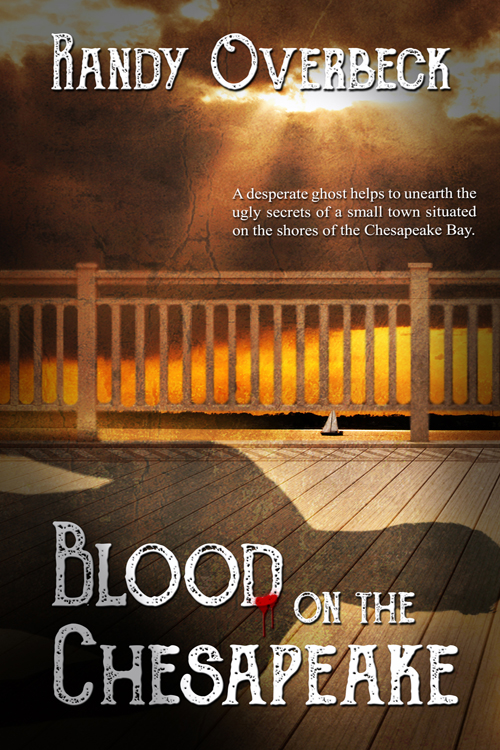
Book Publishing Secrets with Randy Overbeck, Author of 'Blood on the Chesapeake'


Genre: Mystery/Suspense/Ghost Story
Publisher: The Wild Rose Press
INTERVIEW:
Thank you for your time in answering our questions about getting published.  Let’s begin by having you explain to us why you decided to become an author and pen this book?
Randy: I have always been a writer, though not in a creative vein until the last decade or so. In my work life as a teacher and school leader, I was tasked with a great many writing assignments—lesson plans, assessments, newsletters, long range plans, newspaper articles, grant applications, just to name a few. I found I enjoyed these tasks and, based on feedback and performance reviews, was quite good at them. So I decided I’d like to try my hand at writing what I wanted to write, rather than only for work. I began writing fiction, using the people I worked with as inspiration for my characters and what I saw happen in the real world as a jumping off point for my narratives. My novels were born, though not until after a good many fits and starts.
Is this your first book?
Randy: Definitely not. I have two complete novels “in the drawer.” Neither is good enough for publishing, at least yet. I also have one novel published, Leave No Child Behind, a thriller about a terrorist takeover of a high school in the Midwest and the teacher who stands up to the intruders. It was published by another small press, Heroic Teacher Press, and won the 2011 Silver Award for Thriller of the Year from ReadersFavorite.com and I’m quite proud of it. I’m hoping Blood on the Chesapeake does even better.
With this particular book, how did you publish – traditional, small press, Indie, etc. – and why did you choose this method?
Randy: I decided to go again with a small press, The Wild Rose Press. Like most authors, I had hoped to land a strong agent, who in turn could land a contract for the book (or in this case the series) with a major publisher. I did my research and worked the process for about a year. Several agents expressed interest and requested full manuscripts to review, but none ended up making the commitment. I received several emails with “I really like the book, but I’m not in love with it.” So I also did my research on small presses and submitted to a few who I thought might have an interest. Three responded positively and I decided to go with The Wild Rose Press.
Can you tell us a little about your publishing journey?  The pros and cons?
Randy: I’ll be happy to share my experience this far—no copies have been sold yet—and, of course, My earlier experience with the small press on my first novel had been quite positive. In deciding for Blood, I had read a number of good reports on TWRP before I submitted to them and had talked to other authors who had been published by TWRP. They had a good reputation in the field, especially with emerging authors, and, for the most part, my experience has borne that out. They have been easy to work with and have been respectful and positive in our interactions. I’ve been especially impressed with the quickness of their responses in communication. In working with other small presses and agents, it was not unusual to wait weeks and even months for a reply, but TWRP has been quick from the first contact. This attention to my numerous questions and queries has been immediate and polite. I’ve even had conversations with the president and the head of marketing. Of course, I get very little support on the promotion and marketing of my novel, but I pretty much expected that. Successful authors at major firms have shared with me that even they receive very little support in marketing any more. So I went out and found a great marketing consultant and hired her to assist my efforts. So far, it’s been good. Stay tuned and ask me in a year. Of course, it goes without mentioning that you have less control over such things as print, cover art, audio versions, etc, when you sign with a publishing company than if you go alone. It’s been a fair trade off in my mind.
What lessons do you feel you learned about your particular publishing journey and about the publishing industry as a whole?
Randy: I learned how critically important it is that your manuscript is in the best possible shape it is. Of course, I mean free from errors, typos, misspellings, etc. But it should also be the best from point of view of language, characters, dialogue and plot. Second, authors need to go into publishing recognizing that, in today’s crowded literary landscape, they have to work hard to promote and get there book out there, in order to have any chance at any reader success. One thing I’ve learned from the numerous writing conferences I’ve attended is that there are MANY published authors whose work is quite good and who get barely a notice. (Of course, there are also many writers whose work out there is not very good as well.) The point is that you, as an author, need to get comfortable with working even harder after the novel is published, than you had to do to get it published in the first place.
Would you recommend this method of publishing to other authors?
Randy: Overall, yes. I have friends and colleagues who have gone the self-publishing route and have been quite happy and sometimes successful using that venue. But I’ve been very pleased with my two trips through the publishing world via small press. Overall, TWRP has been easy to work with and their reps have listened to my concerns, even though I didn’t always get the answer I wanted. If an author’s works fit their criteria, I’d suggest they explore this avenue to see if it’s right for them.
What’s the best advice you can give to aspiring authors?
Randy: Many writers say that writing is a solitary act, just you and the computer. While I can’t argue with that, I need to add that my writing would never have risen above the minimum without help from outside. I’ve participated in several really good writing conferences—Killer Nashville, Midwest Writers’ Conference, Sluethfest—and have found these experiences invaluable for “priming the pump” and getting me to think beyond my boundaries. Not to mention all the connections I’ve made with fellow writers. But I have found the greatest asset to my writing has been my regular participation in a really great writing group. These fellow writers have been both kind and cruel to my words and my writing has grown as a result.


//////////////
About the book:
Wilshire, Maryland seems like the perfect shore town on the Chesapeake Bay—quiet, scenic, charming—and promises Darrell Henshaw a new start in life and a second chance at love. That is, until he learns the town hides an ugly secret. A thirty-year-old murder in the high school. And a frightening ghost stalking his new office. Burned by an earlier encounter with the spirit world—with the OCD scars to prove it—he does NOT want to get involved. But when the desperate ghost hounds him, Darrell concedes. Assisted by his new love, he follows a trail that leads to the civil rights movement, Dr. Martin Luther King, Jr. and even the Klu Klux Klan. Then, when two locals who try to help are murdered, Darrell is forced to decide if he’s willing to risk his life—and the life of the woman he loves—to expose the killers of a young man he never knew.


Book Publishing Secrets with Adventure Thriller Author Mark H. Jackson @markjackson883


Mark is a qualified solicitor who splits his time between protecting the rights of academics, writing thriller fiction and raising five mostly lovely children. He studied Archaeology and Ancient History at the University of Birmingham with a nod towards alternative theory, focusing on the relationship of the Giza complex to the stars; portolan maps; and the origins of civilisation and religion. It was within this flame the plots for his future novels were born.

Mark’s writing career extends back over a decade and his diverse portfolio includes three novels, a number of short stories and even a six-part sitcom. Long listed for the Amazon Breakthrough Novel Award, he is currently a featured author on the popular writing website, Wattpad, with over 6,000 followers from all around the world and well over one million reads of his first novel. Aside from Wattpad, Mark is an active member on a number of other writing websites, spending his spare time offering editorial and structural advice to fellow authors. Up to now Mark has considered writing as a creative outlet for the myriad of characters and ideas roaming about his head. The time has come to tease them out of hiding and breathe a little life into their lungs.

His latest book is the adventure/thriller The Atlantis Deception.


Thank you for your time in answering our questions about getting published.  Let’s begin by having you explain to us why you decided to become an author and pen this book?
Mark: I suppose my mother is possibly to blame for fueling my interest in reading and writing, but I always wanted to read. I was that child under the sheets late at night with a torch and my latest book. I loved reading and writing just seemed a natural bedfellow. I remember attempting to write an Enid Blyton style mystery at primary school so I guess it was in me from an early age. I was quite a solitary child and just enjoyed the escapism it offered. In what feels like a different lifetime, I studied Archaeology and Ancient History at university with a nod towards alternative theory, focusing on topics such as the relationship of the Giza complex to the stars; portolan maps; and the origins of civilisation and religion. It was within this flame the plot for The Atlantis Deception was born.
Is this your first book?
Mark: The Atlantis Deception is indeed my first foray into the tumultuous world of novel writing, and a book I started writing way back in 2009. The journey to publication has certainly been lengthy and one scattered with numerous moments of elation, despair and lashings of writer’s block.
A German property developer stumbles upon a mysterious and ancient artefact. Enigmatic Cambridge academic, Dr John Hunter, is commissioned to investigate. Hunter's acceptance leads him on a trailblazing adventure from the headquarters of a clandestine organisation in England, to a lost city in the heart of the Brazilian Rainforest, before climaxing deep under the sands of Egypt.
Pioneering theory is spliced by epic battles, daring escapes, and elaborate schemes aimed at unravelling a secret history hidden from humanity for the past twelve thousand years. Although imagined, many of the conclusions are cutting edge and written in such a way so as to blur the line between fact and fiction.
With this particular book, how did you publish – traditional, small press, Indie, etc. – and why did you choose this method?
Mark: I am published by the crowdfunding publisher, Unbound (which had links to Penguin at the time). The route is still in its infancy and certainly cannot be considered an easy option. Unbound set its authors a target figure to publish, somewhere between £4k and 20k depending on how the novel is published, digital only, paperback, hardback and/or audio. As an author, it is then up to you to market and sell your novel on the basis of customers receiving a pre-order and additional rewards depending on the pledge level (art prints, name in the novel or even dinner with the author). In return for successfully negotiating the perilous ups and downs associated with crowdfunding, Unbound offer a much more author friendly contract, particularly in terms of royalties.
Can you tell us a little about your publishing journey?  The pros and cons?
Mark: The application stage is no different to any other traditional publisher although as a result of the funding mechanism I understand around 1 in 10 books are accepted and of those accepted, around 1 in 10 make it through to publication. It is certainly a tough introduction into the world of publication and certainly sets you up for the even tougher post-publication marketing phase.
In terms of the pros of the cons, once through the crowdfunding stage, they are much the same as the usual arguments always cited in the self-publishing vs traditional publishing debate. In a nut shell, self-publishing can reap higher rewards (since the royalties are not shared) whereas a traditional publisher could take up to 90% of any sales you make. However, in return for that 90%, a traditional publisher might give you an advance and at the very least will provide you with all the tools needed to generate a professional product (editors, cover artists, illustrators, proof readers etc). Obviously you can have all this as a self-published author, but you will need to fund everything yourself. These days both routes require authors to market their own work. 
What lessons do you feel you learned about your particular publishing journey and about the publishing industry as a whole?
Mark: The publishing industry as a whole is in a state of transition and I’m not convinced the traditional publishers have really come up with a plan to combat the rise of the self-published author. It is bleak for new authors signing publishing contracts – advances are more and more scarce, marketing budgets for all but the most established names are non-existent. It is crazy that new authors (even when armed with a deal from Penguin) with no following and generally little marketing experience, are expected to almost get on with it themselves. This can include organizing and paying for their own adverts and book/blog tours. It is almost as though they are being set up to fail.
Unbound sit somewhere between self-pubbing and traditional publishing and at the moment I’m quite happy. I’m still aggrieved I have to fund and lead on the marketing of, The Atlantis Deception, but at the same time it has been fun engaging with blogs such as this and working out how to build a following on Twitter and Instagram. Facebook is next on my agenda! 
Would you recommend this method of publishing to other authors?
Mark: It isn’t easy and if you don’t hit the ground running you will fail pretty quickly, but crowdfunding does fill you with an enormous sense of achievement if successful. Once successful you then receive all the benefits of having your book published by a traditional publisher but with a greater share of the royalties. If you have the money to fund yourself I think self-publishing in this climate is almost a no-brainer, but if you don’t have a spare 5-6k or have a burning desire to see your manuscript in your local Waterstones, then Unbound are a great option.
What’s the best advice you can give to aspiring authors?
Mark: Never give up and take any criticism on the chin. Not everyone will appreciate what you do and you will need the hide of a Rhino to survive in this industry!
BOOK BLURB:
A German property developer, Hans Hoffmann, revels in the belief he has discovered the key to unleashing the weapon responsible for sinking Atlantis. Hoffmann requests the help of Cambridge archaeologist, Dr John Hunter to validate his mysterious find. Hunter's acceptance leads the maverick
academic on a journey from the headquarters of a clandestine organisation in England, to a lost city in the heart of the Brazilian Rainforest, and climaxes inside a chamber hidden deep beneath Egyptian Heliopolis. Pioneering theory is spliced by epic battles, daring escapes, and elaborate schemes aimed at unravelling a secret history hidden from humanity for the past twelve thousand years.

Atlantis is a very visual word. A word evoking mystery, forgotten realms, underwater palaces… the list goes on. I find this Plato inspired concept of Atlantis fascinating and read anything and everything I can lay my hands on. The theories are diverse and range from the feasible to the outlandish, but certain concepts keep reoccurring. The Atlantis Deception takes the ideas of accepted and alternative theory, weaving them together to create a believable universe where our past still dictates our future.

The novel follows the trials and tribulations of a fictional Cambridge academic, Dr John Hunter. The focus is not on Atlantis itself, but rather on what happened to its people it the wake of the loss of their homeland. The Atlantis Deception is a classic action adventure tale with heroes, villains, shadowy organisations and self-serving plots, each underpinned by progressive archaeological theory. The novel is written with the aim of both exciting and making readers think in equal measure. Although imagined, many of the conclusions the characters reach are cutting edge and described in such a way so as to blur the line between fact and fiction.

ORDER YOUR COPY:


Amazon: http://bit.ly/Atlantis-Deception