Showing posts with label Suspense. Show all posts

Book Publishing Secrets with Steve Brock #books #bookpublishing


I’ve been an author in search of a novel for just about forty years now. Writing was the first thing I ever wanted to do seriously. Over the years I’ve done quite a variety of things. My first real job, the kind where you have a schedule and get paid hourly, was as a cook at the local Sonic Drive-In. I’ve been a machinist, a forklift driver, a production worker, a computer programmer, an IT guy, an installation manager, a software trainer, and an education department manager. Those are just the employment highlights. Through it all, I was a husband and father, and I attended college at night to get my bachelor’s degree in technology management.

Before all that started, I wanted to be a writer. It just didn’t work out that way. Maybe that’s ok, I’ve had a good life and I have a wonderful family that I am proud to have. I don’t regret any of what I’ve done to support my family over the years. The desire to write has persisted, however, and I took a look at my odometer one day and it read 61 years old. None of us know how high our personal odometer will go, but I knew if I was ever going to be a writer, now was the time.

I’m bringing my lifetime of experience to my novel writing. Many of my characters are loosely based upon people I’ve known in real life. Some of my plot elements are also influenced by real-life experiences as well. As of this writing, my first novel, Half Moon Lake, will be published on Amazon in a few weeks. I have begun work on my second book as well. I hope you will take time to register your email address so I may keep you apprised of announcements and special offers. I’d be thrilled to count you as one of my first dedicated readers.

Steve Brock’s latest novel is Half Moon Lake.

You can visit his website at www.BrockNovels.com or connect with him at Twitter.

Crease Williams lived a charmed life with a bright future. Only in his junior year at Texas Christian University, his skills as a wide receiver had already captured the attention of NFL scouts.

Then a tragedy cost him his family and his desire to play football. Personally devastated, he left his old life behind and got as far from Ft. Worth, TX, and football as he could get.

Keeping mostly to himself, he became a float-plane pilot in the far north of Minnesota. Flying fisherman and hunters into remote locations was how he spent his time. When a group he had flown to Roudy’s Cabin goes missing, he faces accusations and more turmoil than he could have ever imagined. To make matters worse, his quiet existence is upturned by an element from his past bent on vengeance.

Half Moon Lake is Steve Brock’s first novel. A suspenseful mystery written with likable characters and a lighthearted flavor.

Book Information

Release Date: March 30, 2022

Publisher:  Steve Brock

Soft Cover: ISBN: 978-0578391977; 187 pages; $9.99; Kindle Unlimited FREE

Amazon: https://amzn.to/3knaPfd


📙 Thank you for your time in answering our questions about getting published.  Let’s begin by having you explain to us why you decided to become an author and pen this book?

Steve: Writing is something I intended to do even back in high school. Life had other plans for me and it has taken me forty years to come to a place in life where I could fulfill that dream.

📙 Is this your first book?

Steve: Yes, it is.


📙With this particular book, how did you publish – traditional, small press, Indie, etc. – and why did you choose this method?

Steve: I independently published. I didn’t pursue traditional publishing. After seeking out advice from some authors that have long resumes, I learned there are a lot of negative aspects to traditional publishing that can be avoided by publishing independently.

📙Can you tell us a little about your publishing journey?  The pros and cons?

Steve: It was mostly positive. As I said, I sought out help from experienced authors, and that helped me in a lot of ways. As for the pros and cons, the most positive thing about publishing yourself is you can set your own pace and you don’t have anyone else’s deadlines to meet. On the down side, you are completely on your own, and if this is your first publishing experience there are a lot of lessons to be learned. Things like finding a professional editor and a professional book cover designer are issues I didn’t think about before I started down this road.

📙What lessons do you feel you learned about your particular publishing journey and about the publishing industry as a whole?

Steve: Publishing on your own puts everything on your shoulders. Finding all the assistance you will need to prepare your book for publication, learning the steps involved in getting your book published are just two of the things a new author must deal with. In addition to that, after publication, all the marketing has to be done as well. With an average of 450 books being published every day, it isn’t easy to draw attention to yours.

📙Would you recommend this method of publishing to other authors?

Steve: It’s hard to say without having anything else to compare it to. I know publishing has been changing the last few years. The days of the large publishing companies deciding which books are published are over. Virtually anyone can publish a book if they are willing to put in the work. Before I started writing if I had been given the option of traditional publishing I’m sure I would have taken it. If for no other reason than to have someone to guide me through the process the first time.


📙What’s the best advice you can give to aspiring authors?

Steve: Find a mentor, someone who has experience in some aspect of book writing or publishing. Once you get going, most things you will learn as you go, but having someone to bounce ideas off of is really valuable.


Book Publishing Secrets with Lee Matthew Goldberg, Author of The Desire Card


Lee Matthew Goldberg is the author of SLOW DOWN and THE MENTOR (St. Martin’s Press), which was acquired by Macmillan Entertainment with the film in development. He has been published in multiple languages and nominated for the 2018 Prix du Polar. The first two books in a thriller series, THE DESIRE CARD and PREY NO MORE, are forthcoming from Fahrenheit Press in winter 2019. His pilots and screenplays have been finalists in Script Pipeline, Stage 32, We Screenplay, the New York Screenplay, Screencraft, and the Hollywood Screenplay contests. After graduating with an MFA from the New School, his writing has also appeared in the anthology DIRTY BOULEVARD, The Millions, The Montreal Review, The Adirondack Review, Essays & Fictions, The New Plains Review, and others. He is the co-curator of The Guerrilla Lit Reading Series (guerrillalit.wordpress.com). He lives in New York City. Follow him at leematthewgoldberg.com and @LeeMatthewG.

WEBSITE & SOCIAL LINKS:

WEBSITE | TWITTER | FACEBOOK


BOOK BLURB:

Any wish fulfilled for the right price. That's the promise the Desire Card gives to its elite clients. But if the Card doesn’t feel like they’ve been justly compensated, the “price” will be more menacing than the clients could ever imagine.   

Harrison Stockton learns this lesson all too well. Harrison has lived an adult life of privilege and
excess: a high-powered job on Wall Street along with a fondness for alcohol and pills, and a family he adores, yet has no time for. All of this comes crashing to a halt when he loses his executive job and discovers he has liver cirrhosis with mere months left to live.

After finding himself far down on the donor list, Harrison takes matters into his own hands. This decision sparks a gritty and gripping quest that takes him to the slums of Mumbai in search of a black market organ and forces him under the Desire Card’s thumb. When his moral descent threatens his wife and children, Harrison must decide whether to save himself at any cost, or do what’s right and put a stop to the Card.

THE DESIRE CARD is a taut international thriller that explores what a man will do to survive when money isn’t always enough to get everything he desires. It’s the first book in a series followed by PREY NO MORE that focuses on other people indebted to this sinister organization, where the actual price is the cost of one’s soul.

PRAISE:

"Careful what you wish for, especially from a nefarious shadow organization, in this gripping start to Lee Matthew Goldberg's fast-paced, highly compelling, buzz worthy new series. If you love characters morally compromised, richly drawn, and constantly surprising, you'll love THE DESIRE CARD. I burned through the first book and can't wait to get my hands on PREY NO MORE to see where this endlessly exciting story takes me next! Loved it!” - Daniel Palmer, critically acclaimed suspense author

ORDER YOUR COPY:

Amazon


Thank you for your time in answering our questions about getting published.  Let’s begin by having you explain to us why you decided to become an author and pen this book?
I’ve always been a writer. It has been a dream career for me.
Is this your first book?
No, it is my third published book after Slow Down and The Mentor
With this particular book, how did you publish – traditional, small press, Indie, etc. – and why did you choose this method?
This is published by an Indie publisher. They do great crime fiction and bought the first two books in the series so were a good fit.
Can you tell us a little about your publishing journey?  The pros and cons?
It’s been a long ride. It took a while to get an agent and sell my first book. Even now, it’s not easy to sell every book. But I love to write and for me, that’s the easiest part.
What lessons do you feel you learned about your particular publishing journey and about the publishing industry as a whole?
To never give up. I’ve gotten so many rejections it would have been easy to just pack it all in, but I always was determined to be published and carve out a career.
Would you recommend this method of publishing to other authors?
Yeah, if a great publisher wants your book, sure, what’s stopping you?
What’s the best advice you can give to aspiring authors?
Edit, and then edit more, and then edit again. Treat it like a job, but don’t forget why you love to do it.

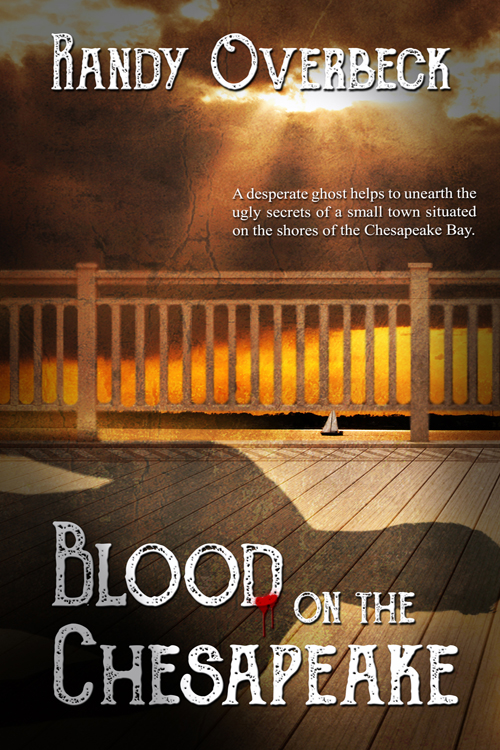
Book Publishing Secrets with Randy Overbeck, Author of 'Blood on the Chesapeake'


Genre: Mystery/Suspense/Ghost Story
Publisher: The Wild Rose Press
INTERVIEW:
Thank you for your time in answering our questions about getting published.  Let’s begin by having you explain to us why you decided to become an author and pen this book?
Randy: I have always been a writer, though not in a creative vein until the last decade or so. In my work life as a teacher and school leader, I was tasked with a great many writing assignments—lesson plans, assessments, newsletters, long range plans, newspaper articles, grant applications, just to name a few. I found I enjoyed these tasks and, based on feedback and performance reviews, was quite good at them. So I decided I’d like to try my hand at writing what I wanted to write, rather than only for work. I began writing fiction, using the people I worked with as inspiration for my characters and what I saw happen in the real world as a jumping off point for my narratives. My novels were born, though not until after a good many fits and starts.
Is this your first book?
Randy: Definitely not. I have two complete novels “in the drawer.” Neither is good enough for publishing, at least yet. I also have one novel published, Leave No Child Behind, a thriller about a terrorist takeover of a high school in the Midwest and the teacher who stands up to the intruders. It was published by another small press, Heroic Teacher Press, and won the 2011 Silver Award for Thriller of the Year from ReadersFavorite.com and I’m quite proud of it. I’m hoping Blood on the Chesapeake does even better.
With this particular book, how did you publish – traditional, small press, Indie, etc. – and why did you choose this method?
Randy: I decided to go again with a small press, The Wild Rose Press. Like most authors, I had hoped to land a strong agent, who in turn could land a contract for the book (or in this case the series) with a major publisher. I did my research and worked the process for about a year. Several agents expressed interest and requested full manuscripts to review, but none ended up making the commitment. I received several emails with “I really like the book, but I’m not in love with it.” So I also did my research on small presses and submitted to a few who I thought might have an interest. Three responded positively and I decided to go with The Wild Rose Press.
Can you tell us a little about your publishing journey?  The pros and cons?
Randy: I’ll be happy to share my experience this far—no copies have been sold yet—and, of course, My earlier experience with the small press on my first novel had been quite positive. In deciding for Blood, I had read a number of good reports on TWRP before I submitted to them and had talked to other authors who had been published by TWRP. They had a good reputation in the field, especially with emerging authors, and, for the most part, my experience has borne that out. They have been easy to work with and have been respectful and positive in our interactions. I’ve been especially impressed with the quickness of their responses in communication. In working with other small presses and agents, it was not unusual to wait weeks and even months for a reply, but TWRP has been quick from the first contact. This attention to my numerous questions and queries has been immediate and polite. I’ve even had conversations with the president and the head of marketing. Of course, I get very little support on the promotion and marketing of my novel, but I pretty much expected that. Successful authors at major firms have shared with me that even they receive very little support in marketing any more. So I went out and found a great marketing consultant and hired her to assist my efforts. So far, it’s been good. Stay tuned and ask me in a year. Of course, it goes without mentioning that you have less control over such things as print, cover art, audio versions, etc, when you sign with a publishing company than if you go alone. It’s been a fair trade off in my mind.
What lessons do you feel you learned about your particular publishing journey and about the publishing industry as a whole?
Randy: I learned how critically important it is that your manuscript is in the best possible shape it is. Of course, I mean free from errors, typos, misspellings, etc. But it should also be the best from point of view of language, characters, dialogue and plot. Second, authors need to go into publishing recognizing that, in today’s crowded literary landscape, they have to work hard to promote and get there book out there, in order to have any chance at any reader success. One thing I’ve learned from the numerous writing conferences I’ve attended is that there are MANY published authors whose work is quite good and who get barely a notice. (Of course, there are also many writers whose work out there is not very good as well.) The point is that you, as an author, need to get comfortable with working even harder after the novel is published, than you had to do to get it published in the first place.
Would you recommend this method of publishing to other authors?
Randy: Overall, yes. I have friends and colleagues who have gone the self-publishing route and have been quite happy and sometimes successful using that venue. But I’ve been very pleased with my two trips through the publishing world via small press. Overall, TWRP has been easy to work with and their reps have listened to my concerns, even though I didn’t always get the answer I wanted. If an author’s works fit their criteria, I’d suggest they explore this avenue to see if it’s right for them.
What’s the best advice you can give to aspiring authors?
Randy: Many writers say that writing is a solitary act, just you and the computer. While I can’t argue with that, I need to add that my writing would never have risen above the minimum without help from outside. I’ve participated in several really good writing conferences—Killer Nashville, Midwest Writers’ Conference, Sluethfest—and have found these experiences invaluable for “priming the pump” and getting me to think beyond my boundaries. Not to mention all the connections I’ve made with fellow writers. But I have found the greatest asset to my writing has been my regular participation in a really great writing group. These fellow writers have been both kind and cruel to my words and my writing has grown as a result.


//////////////
About the book:
Wilshire, Maryland seems like the perfect shore town on the Chesapeake Bay—quiet, scenic, charming—and promises Darrell Henshaw a new start in life and a second chance at love. That is, until he learns the town hides an ugly secret. A thirty-year-old murder in the high school. And a frightening ghost stalking his new office. Burned by an earlier encounter with the spirit world—with the OCD scars to prove it—he does NOT want to get involved. But when the desperate ghost hounds him, Darrell concedes. Assisted by his new love, he follows a trail that leads to the civil rights movement, Dr. Martin Luther King, Jr. and even the Klu Klux Klan. Then, when two locals who try to help are murdered, Darrell is forced to decide if he’s willing to risk his life—and the life of the woman he loves—to expose the killers of a young man he never knew.


Book Publishing Secrets with Ray Sutherland, Author of 'Secret Agent Angel'


Name: Ray Sutherland

Book Title: Secret Agent Angel
Find out more: Amazon / B&N / Kobo 


Thank you for your time in answering our questions about getting published.  Let’s begin by having you explain to us why you decided to become an author and pen this book?
Author: I began to write stories when I was in grade school, just for my own entertainment. The earliest I remember was in the sixth grade. I continued writing, off and on, until I began teaching.
Once as I was reading a Matt Helm secret agent novel by Donald Hamilton, it occurred to me that if angels are God’s secret agents, as Billy Graham said, there must be some really good stories they could tell. So, in Secret Agent Angel,  I told some of those stories from the point of view of the angel. While that turned out to be an interesting challenge and a lot of work, it also turned out to be a lot of fun as well. I also thought that it turned out rather well. I began writing for my own entertainment, and Secret Agent Angel certainly entertained me and my first readers.
Is this your first book?
Author: It is my first published novel. I have some earlier academic publications.
With this particular book, how did you publish – traditional, small press, Indie, etc. – and why did you choose this method?
Author: I selected Black Opal Press, which I think would be called a small traditional press. I liked the availability of the publishing staff and the community of authors on-line  that write for Black Opal. The people at Black Opal were very patient and helpful.
Can you tell us a little about your publishing journey?  The pros and cons?
Author: First, I had to write the book and get it finished, which entailed some determination and hard work. The process of writing was quite enjoyable, but the process of getting the manuscript finished and book proposals written and submitting it was even harder work and considerably less fun. The hard work and persistence paid off with a published book.
What lessons do you feel you learned about your particular publishing journey and about the publishing industry as a whole?
Author: I learned the value of persistence . You must write, even when you don’t feel like it. You must format the manuscript and write a good proposal, all of which required determination and persistence.
Would you recommend this method of publishing to other authors?
Author: I am happy with the traditional publishing method and plan to utilize it again for my next book. I also hear good reports about the other methods, especially indie and on-line publishing, but I like traditional and hope to stay with it.
What’s the best advice you can give to aspiring authors?
Author: Robert A. Heinlein said it wonderfully well. “You must write. You must finish what you write. You must put the work on the market. You must keep the work on the market until it is sold.” I followed these rules and they work. If you want to be a published writer, you must follow them, too.

About the book:
If angels are God’s secret agents then you know there are some really good secret agent stories they could tell, and my first novel Secret Agent Angel tells some of them in first person as told by one of the angels. Samuel is an angel who often comes to earth in human flesh and blood form to be God’s secret agent. Samuel specializes in persuasion and encouragement of people in a crisis, refers to God as “the Boss,” enjoys the unpredictability of humans, has a weird sense of humor, and is a junk food junkie. By design, he often is as unaware of the Boss’s real purpose as are the humans he comes to help and as a result has some significant misadventures along the way and even some failures. But he persists in the certainty that God will put it all to good use, even if humanity and even Samuel himself don’t see how.
Find out more: Amazon / B&N / Kobo