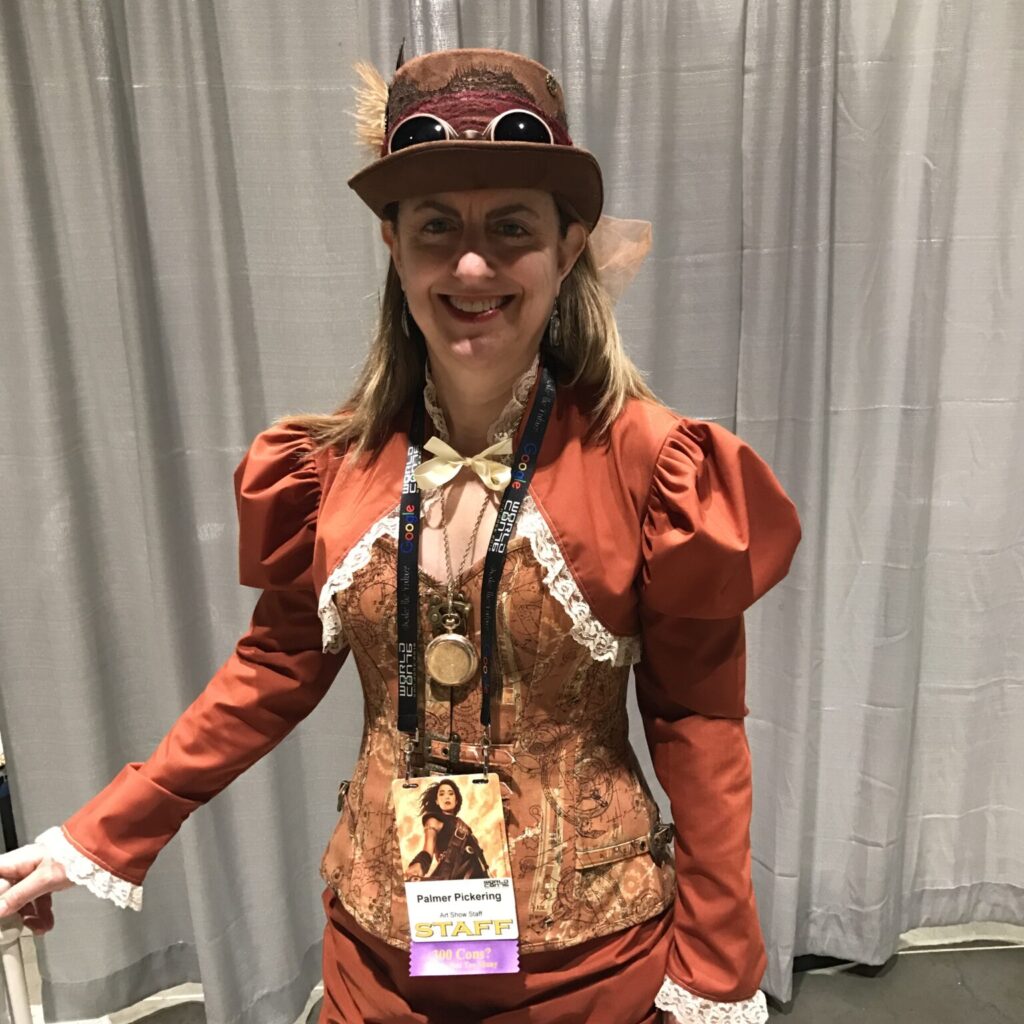
She currently works in Silicon Valley in the gaming industry and high tech. In addition, Palmer holds a certificate in Chinese Acupressure, is a certified solar panel installer, and studied Tibetan Buddhism with the 14th Dalai Lama.
She lives and writes in the magical redwood forest of the Santa Cruz Mountains, California.
Her latest book is the scifi fantasy for adults, Moon Deeds: Star Children Saga Book One.
You can visit her website at www.MythologyPress.com or connect with her on Twitter, Facebook, Instagram and Pinterest.


“The path to power is cloaked in shadows, so if you avoid all the shadows, you’ll never learn anything.”
It’s 2090: the last outpost of freedom is the moon, the best defense against technology is magic, and the only hope for humankind rests in the hands of the Star Children.
Twins Cassidy and Torr must save Earth from a ruthless enemy at a time when the only force more powerful than alien technology is magic. Moon Deeds launches the siblings’ journey across the galaxy, where they must learn their power as the Star Children, claim their shamanic heritage, and battle dark forces that threaten humankind.
The Star Children Saga follows Cassidy and Torr as they slowly awaken to their destiny as the twin Star Children, born every millennium to reconnect with the source of all life. They come to discover the sheer enormity of their task: to find our ancestors on a lost planet across the galaxy and save humanity from a spiraling descent into darkness. The powers they must wield to accomplish this task are truly frightening and put at risk everything they love.
Come along with twenty-year-old twins Cassidy and Torr, who inherited deeds to land parcels on the moon. They want to use their moon deeds to get off Earth and escape a brutal dictatorship. But first they must unlock their shaman powers.
A rollicking yet poignant adventure in the not too distant future, when we have colonized the moon and nearly lost Earth to a dictatorship. Only the shamans remain free, plus the lucky ones who escaped to the moon.
Join the adventure! An addictive space opera, science-fantasy series.
“This is a marvelous book. The characters are compelling, complex, and emotional. The future described is neither all evil nor all good, and it’s described so realistically that I can still feel the moon dust in my nose and expect to see large packing containers around every corner. The text is delightfully written with none of the bad grammar that makes picky people like me wince even in an otherwise great story. Alas, this is just the first book of the series, and it appears I’ll have to wait a whole year for the next one. I really need to know *now* what happens next!” – Garden Reader
“I was totally captivated by this story. It is set just far enough into our future that I could see it all unfold. This tale has it all, mystery, magic, aliens, war, family, friendship and love. The authors ability to paint landscapes with words is amazing! I can not wait for book two to come out. I must know the fate of the Star Children!” – VR
“Anything dealing with the moon is almost immediately mystical and magical. Throw in a heart racing adventure and characters that will leave a mark on your heart and you have a masterpiece!” – Taylor Johnson (Educator, Netgalley)
“I found this novel to be as much a psychological thriller as it is a science fiction adventure, and the draw-in happens almost instantly. This is unquestionably one of the best books I’ve read this year and Pickering has roped in an entire family as new fans. I’d give Moon Deeds a whole bucket of stars if I could.” – Asher Syed (Readers’ Favorite)
“There is so much to love about this book, from its complex and intricately woven plot filled with tension, strife, and discovery, to the personal attachment you begin to build with the characters due to finely executed character building, engaging personalities, and difficulties in both moral dilemmas and situations. The pace is perfect to build tension, and I loved the length of this book.” – K.J. Simmill (Readers’ Favorite)
Book Information
Release Date: May 25, 2019
Publisher: Mythology Press
Soft Cover: ISBN: 978-1732568808; 598 pages; $21.99; E-Book, $.99; Audiobook, FREE.
Book Trailer: https://www.youtube.com/watch?v=Xt13Js_M-P4
Amazon: https://amzn.to/3uKWq2o
Barnes & Noble: https://bit.ly/3rQteFx
📙 Thank you for your time in answering our questions about getting published. Let’s begin by having you explain to us why you decided to become an author and pen this book?
Palmer: I always wrote stories, ever since I was a young child. I love reading, and being an author was always my life’s goal. With Moon Deeds, I decided to write in the genre I most like to read, which is speculative fiction.
📙 Is this your first book?
Palmer: Moon Deeds is my first published book. I recently released its sequel, Light Fighters. They are the first books of the Star Children Saga, a series which will be several books long. I completed another book before Moon Deeds, but haven’t done the work to publish it.
📙With this particular book, how did you publish – traditional, small press, Indie, etc. – and why did you choose this method?
Palmer: I self-published under my Indie imprint, Mythology Press. I decided to self-publish after many years of unsuccessfully courting agents and the traditional publishers. I have a professional background in publishing, so I understand the process, and finally just decided to do it myself.
📙Can you tell us a little about your publishing journey? The pros and cons?
Palmer: The pros of self-publishing are many, especially now, and especially in genre fiction, where half of all books sold are now self-published.
The self-publishing industry has evolved drastically in the past ten years, offering tools and communities that rival those of traditional publishers. By that I mean, authors can now desktop publish on a normal computer, no longer relying on typesetters. They can print-on-demand, avoiding the costly investment of a large print run. They can publish ebooks. Many companies and organizations support self-published authors now, from desktop publishing tools, to distribution networks, to publicists, to bloggers (like yourself), to competitions.
A biggest advantage to self-publishing is the control you have over the creative process and all aspects of publishing. No one dictates what content to write or cut, what the page count must be, what cover art to use, or when and how to publish your work.
On the other hand, the biggest advantages of traditional publishers are their professional editorial teams, the quality controls built into their process, their brand name, and immediate access to the big conventions and awards. Traditional publishers do large print runs, resulting in lower prices than print-on-demand. Most important of all, in my opinion, they have the ability to get printed books in brick-and-mortar bookstores, something that is nearly impossible to do for indies, aside from consignment at small bookstores. Unless you’ve already established a huge following as an indie, most bookstores simply don’t want to give up shelf space or take the risk of carrying a book that might not sell, even if you distribute via one of the big distributors and accept returns.
📙What lessons do you feel you learned about your particular publishing journey and about the publishing industry as a whole?
Palmer: I’ve been at this for a few years now, and a recent revelation is the importance of community. There is a large network of authors, reviewers, bloggers, and avid readers who participate in online book clubs, blogs, Discord channels, Facebook groups, Twitter, Reddit, etc. I recommend joining some of these and developing relationships. Do author swaps, where you read each other’s books and support each with feedback and reviews. Do buddy reads. Engage in discussions about other books. Volunteer at conventions. Sign up to speak on panels. Be a part of the community.
📙Would you recommend this method of publishing to other authors?
Palmer: Yes, I definitely would. I’ve found self-publishing to be immensely gratifying. It sounds cliché, but it’s really all about the journey—enjoying the process of writing and editing, working with editors and artists, and supporting others on their journey.
📙What’s the best advice you can give to aspiring authors?
Palmer: For aspiring writers, you must write. Don’t think about it, or plan, or wish, just sit down and put words on paper. Every day if you can. The stories don’t have to be good, just start with anything that you find fun to write. Writing is a craft and takes a ton of practice.
For aspiring authors (those who have finished stories but haven’t published), I recommend first hiring editors, or swapping editing and beta reading with others. (Side note: For novels, I recommend that your book is actually finished before you start querying. For unknown fiction authors, it’s very rare to get a book deal on spec.) Give the finished work to beta readers and then talk to them about their impressions, to make sure what you intended to convey actually worked. Then, when you are confident that your work is ready, try to find an agent for a couple of years (yes, years), and in that time also submit your manuscript to those who accept unsolicited works, since they often sit in a slush pile for a while. After that, if you are proud of your work and have received positive feedback from others, then try self-publishing. While all that is going on, write your next book!

📙 Thank you for your time in answering our questions about getting published. Let’s begin by having you explain to us why you decided to become an author and pen this book?
Palmer: I always wrote stories, ever since I was a young child. I love reading, and being an author was always my life’s goal. With Moon Deeds, I decided to write in the genre I most like to read, which is speculative fiction.
📙 Is this your first book?
Palmer: Moon Deeds is my first published book. I recently released its sequel, Light Fighters. They are the first books of the Star Children Saga, a series which will be several books long. I completed another book before Moon Deeds, but haven’t done the work to publish it.
📙With this particular book, how did you publish – traditional, small press, Indie, etc. – and why did you choose this method?
Palmer: I self-published under my Indie imprint, Mythology Press. I decided to self-publish after many years of unsuccessfully courting agents and the traditional publishers. I have a professional background in publishing, so I understand the process, and finally just decided to do it myself.
📙Can you tell us a little about your publishing journey? The pros and cons?
Palmer: The pros of self-publishing are many, especially now, and especially in genre fiction, where half of all books sold are now self-published.
The self-publishing industry has evolved drastically in the past ten years, offering tools and communities that rival those of traditional publishers. By that I mean, authors can now desktop publish on a normal computer, no longer relying on typesetters. They can print-on-demand, avoiding the costly investment of a large print run. They can publish ebooks. Many companies and organizations support self-published authors now, from desktop publishing tools, to distribution networks, to publicists, to bloggers (like yourself), to competitions.
A biggest advantage to self-publishing is the control you have over the creative process and all aspects of publishing. No one dictates what content to write or cut, what the page count must be, what cover art to use, or when and how to publish your work.
On the other hand, the biggest advantages of traditional publishers are their professional editorial teams, the quality controls built into their process, their brand name, and immediate access to the big conventions and awards. Traditional publishers do large print runs, resulting in lower prices than print-on-demand. Most important of all, in my opinion, they have the ability to get printed books in brick-and-mortar bookstores, something that is nearly impossible to do for indies, aside from consignment at small bookstores. Unless you’ve already established a huge following as an indie, most bookstores simply don’t want to give up shelf space or take the risk of carrying a book that might not sell, even if you distribute via one of the big distributors and accept returns.
📙What lessons do you feel you learned about your particular publishing journey and about the publishing industry as a whole?
Palmer: I’ve been at this for a few years now, and a recent revelation is the importance of community. There is a large network of authors, reviewers, bloggers, and avid readers who participate in online book clubs, blogs, Discord channels, Facebook groups, Twitter, Reddit, etc. I recommend joining some of these and developing relationships. Do author swaps, where you read each other’s books and support each with feedback and reviews. Do buddy reads. Engage in discussions about other books. Volunteer at conventions. Sign up to speak on panels. Be a part of the community.
📙Would you recommend this method of publishing to other authors?
Palmer: Yes, I definitely would. I’ve found self-publishing to be immensely gratifying. It sounds cliché, but it’s really all about the journey—enjoying the process of writing and editing, working with editors and artists, and supporting others on their journey.
📙What’s the best advice you can give to aspiring authors?
Palmer: For aspiring writers, you must write. Don’t think about it, or plan, or wish, just sit down and put words on paper. Every day if you can. The stories don’t have to be good, just start with anything that you find fun to write. Writing is a craft and takes a ton of practice.
For aspiring authors (those who have finished stories but haven’t published), I recommend first hiring editors, or swapping editing and beta reading with others. (Side note: For novels, I recommend that your book is actually finished before you start querying. For unknown fiction authors, it’s very rare to get a book deal on spec.) Give the finished work to beta readers and then talk to them about their impressions, to make sure what you intended to convey actually worked. Then, when you are confident that your work is ready, try to find an agent for a couple of years (yes, years), and in that time also submit your manuscript to those who accept unsolicited works, since they often sit in a slush pile for a while. After that, if you are proud of your work and have received positive feedback from others, then try self-publishing. While all that is going on, write your next book!


