
Name: Michael
Bowen
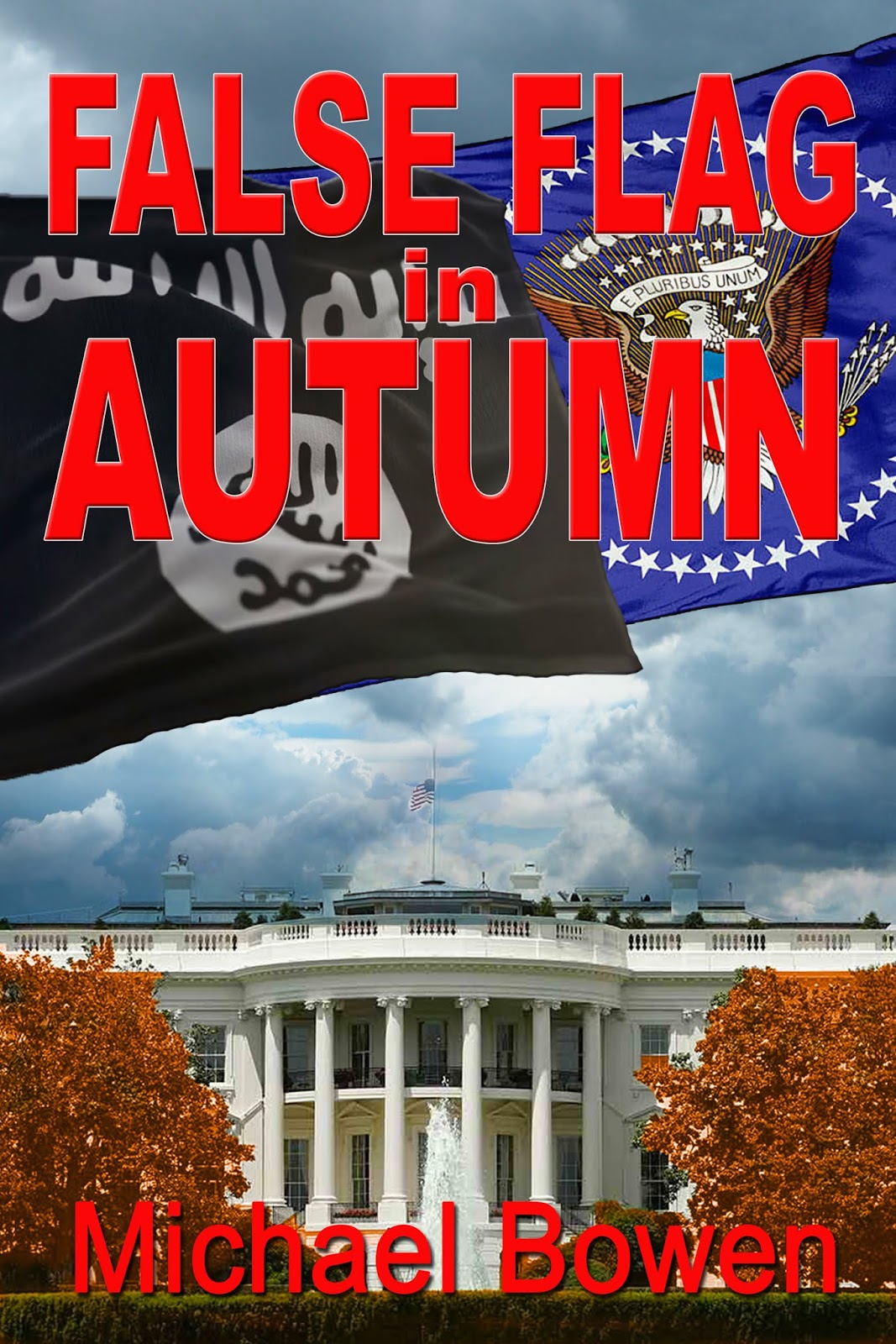
Book Title: False
Flag in Autumn
Genre: Political
thriller
Publisher: Farragut
Square Publications
Website: www.michalbowenmysteries.com
Thank you for your time in answering our
questions about getting published. Let’s
begin by having you explain to us why you decided to become an author and pen
this book?
Mike: We are now living through
the most important American political period in my lifetime – and at 68 years
of age, I have lived through Watergate, the aftermath of the Vietnam War, the
end of the Cold War, and the economic upheaval accompanying globalization. It has generated voluminous commentary by
smart people – and 98% of that commentary, on both sides, is twaddle. Something is going on here that the usual
ways of analyzing politics can’t seem to get at properly. I’m a storyteller, and I thought that maybe I
could get at what the other approaches are missing by telling a story about
it. After all, fiction is truth
liberated from the tyranny of fact.
Is this your first book?
Mike: Nope.
Harper & Row published my first novel, Can’t Miss, in
1987. I’ve had something like twenty –
mostly mysteries, but with political satire mixed in – since then.
With this particular book, how did you publish
– traditional, small press, Indie, etc. – and why did you choose this method?
Mike: I self-published through Farragut Square
Publications because I tried every other avenue and hit nothing but dead ends. The great satirist Evelyn Waugh said that he
turned to writing because he had tried every other profession and failed. That’s how I ended up going to the route I
did with False Flag in Autumn.
Can you tell us a little about your publishing
journey? The pros and cons?
Mike: A prominent small-press mystery publisher
bought the story, paid for it in full – and then got cold feet and bailed
because it felt its readers had, in its words, “Trump fatigue.” I’d had books rejected before, but I’d never
had a publisher give me its hard-earned money, say “Mike delivered” – direct
quote – and then have second thoughts.
Another prominent publisher raved about what a fully developed character
Josie Kendal was, but said that it didn’t know how to place political
stories. I got the message and went with
Captain David Farragut’s famous line from the Battle of Mobile Bay: “Damn the torpedoes! Full speed ahead!” The greatest part of the experience was hiring
an independent editor to help me with the story. She was tremendous – and because I myself was
paying her, I felt that I had to defer to her more readily than I had to editors
my publishers were paying.
What lessons do you feel you learned about
your particular publishing journey and about the publishing industry as a
whole?
Mike: Given the times we live in, I absolutely do not blame
established publishers for deciding that they simply don’t need the hassle and
aggravation that could well be waiting for them if they turn out a topical
political novel. Publishing is a
business, not a hobby, and unless a publisher has a guaranteed bankable author
with a string of bestsellers on his resumé, why should it risk a Twitter-storm
from the right, or the left, or both, complete with angry demands that
bookstores and readers boycott all of that publisher’s titles? For that matter, why should it risk
alienating readers who it thinks want Nancy Drew Goes to Washington
instead of a shrewd, manipulative Washington apparatchik who (as Josie Kendal
puts it) “can pull out every stop on the organ – and you don’t want to be in
church when it happens”? I’ve learned
that politics is toxic right now, and that the intimidation tactics deployed by
both sides have worked.
Would you recommend this method of publishing
to other authors?
Mike: It’s like the proverbial question sometimes
put to lawyers by college students: do
you think I should go to law school? The
answer is, “Unless you want to be a lawyer so much that nothing I could say
could make the slightest difference, the answer is no.” Unless you think what you have to say is
potentially so important that it simply cannot be left unsaid, then the odds
are that two years from now you’ll be richer and happier if you don’t resort to
self-publication – even under a name as clever as Farragut Square Publications.
What’s the best advice you can give to
aspiring authors?
Mike: Remember every time you sit down at the
keyboard that the great accomplishment isn’t getting a book published – it’s
telling a story, even if no one but you and your friends in your writing group
ever read that story. If you truly
believe in the story you’ve written, then in writing that story you have
accomplished something far greater than a hugely successful author who has gone
on automatic pilot to turn out one more entry in a franchise that deliberately
gives readers something familiar and non-threatening. At a more practical level, always stop
writing in a given session before you want to.
That will make you hungry to go back.
If you stay up until three a.m. and crank out eight chapters, it will be
two weeks before you go back to the story.
About False Flag in Autumn: Why wasn’t there an October surprise before
the 2018 midterm elections? The
irrepressible Josie Kendall, introduced in 2016’s Damage Control (“ . .
. consistently delightful . . . . Bowen’s ebullient antidote to election season
blues” – Kirkus Reviews) finds herself in the middle of that provocative
question. She no sooner answers it than
she faces one even more dramatic: What
about 2020, with control of the White House at stake? Josie will have to decide whether to leave
the Beltway cocoon, where the weapons are spin, winks, nudges, and strategic
leaks, and venture into a world where the weapons are actual weapons. Josie knows that you don’t do politics with
choir girls, and that to end up on the side of the angels you sometimes have to
find angels who play a little dirty.
M.C.: What themes do you explore in False Flag in Autumn?
Mike: Integrity,
redemption, and the willingness to know yourself – to look in the mirror
finally and see something that you’re not particularly comfortable with.
M.C.: Why do you write?
Mike: God has given me the gift of
being able to tell stories that engage the interest and emotions of other
people. To borrow a line from the movie Chariots
of Fire, when I use that gift I can feel His pleasure.
M.C.: When
do you feel most creative?
Mike: When I see something – e.g.,
a computer bag going through the luggage screener at an airport, that could
be switched with an identical bag with neither the owner nor anyone else being
any the wiser – and realize that no one else looking at exactly the same scene
has seen what I just saw. And when I
wonder What if? What if someone
threatens to kill you unless you stop sleeping with his wife, and you’re not
sleeping with anyone else’s wife?
M.C.: How picky are you with language?
Mike: I’m an unapologetic,
old-school pedant. I’ve tried – hard –
to check my tendency to correct grammar and diction in conversation, but I
still yell corrections at my television screen:
“fewer, not less, to her and me, not to her and
I, supine, not prone, espionage, not treason,
you semi-literate cretin.” In a
deposition once, an expert witness referred three times to his
“mythology.” I finally said, “I think
you mean ‘methodology.’ ‘Mythology’ is
what I’d call it if we had a jury here.”
Opposing counsel once told me in a letter that he found one of my
statements “incredulous.” I replied that
I thought he meant “incredible.” He
peevishly responded, “Please don’t correct my grammar.” I wrote back, “I wasn’t correcting your
grammar, I was correcting your diction.”
M.C.: When you write, do you sometimes feel as though you are being
manipulated from afar?
Mike: Nope. The internal logic of plot or character can
take me in unanticipated and even surprising directions, but that’s because I
haven’t thought things through thoroughly enough before I started to write –
not because a muse is playing head-games with me.
M.C.: What is your worst time as a writer?
Mike: Spotting a typo – or, even
worse, a substantive factual error – when I’m reading the printed book and it’s
too late to make a correction.
M.C.: Your best?
Mike: When I’m reading something
I’ve written and I know the story perfectly well, but I want to go on
reading even so simply because I’m enjoying the prose and the way the story is
playing out.
M.C.: Is there anything that would
stop you from writing?
Mike: No. If someone threatened to disclose my most embarrassing
secret unless I promised never to write another word, I’d say, “You’re too
late. I’ve already revealed it in at
least three stories.”
M.C.: What’s the happiest moment
you’ve lived as an author?
Mike: When I realized that you
could lock a snap-lock on the inside of a room by blocking the latch with an
ice cube and then stepping outside and closing the door, so that the lock would
snap shut when the ice cube melted; and then verified with a lock I bought and
installed expressly for the purpose, and an ice cube and a camera, that the
trick would actually work.
M.C.: Is writing an obsession to
you?
Mike: Absolutely. If the apocalypse comes before I die, I’ll
probably be typing right up until an angel on a green horse gallops up to let me
know what my fate is
M.C.: Are the stories you create
connected to you in some way?
Mike: Sure. My protagonists have strengths and weaknesses
(and good habits and bad habits) that I don’t have, and they tend to lead more
interesting lives (especially now that I’ve retired from practicing law), but
every emotion, every desire, every conflict of conscience, every resistance to
or acquiescence in temptation that I write about is an extrapolation of
something that I have felt or experienced or imagined.
M.C.: Ray Bradbury once said, “You
must stay drunk on writing so reality cannot destroy you.” Thoughts?
Mike: Bradbury has a far more sensitive soul than
I do. I practiced law for thirty-nine
years. What does a lawyer do when he has
secured a not guilty verdict for a client he knows perfectly well was as guilty
as Judas Iscariot? I’ll tell you what he
does. He goes home; loosens his tie and
unbuttons the top button on his shirt; puts jazz on his CD player; pours two
fingers of scotch; listens to Miles
Davis or John Coltrane until he falls asleep; then gets up the next morning and
goes back to work. Reality doesn’t stand
a chance
M.C.: Do
you have a website or blog where readers can find out more about you and your
work?
Mike: www.michaelbowenmysteries.com.


